.jpg)
Legal leaders everywhere wrestle with the same set of challenges: navigating big technology decisions, keeping their people supported through change, and building firms that can scale without burning everyone out.
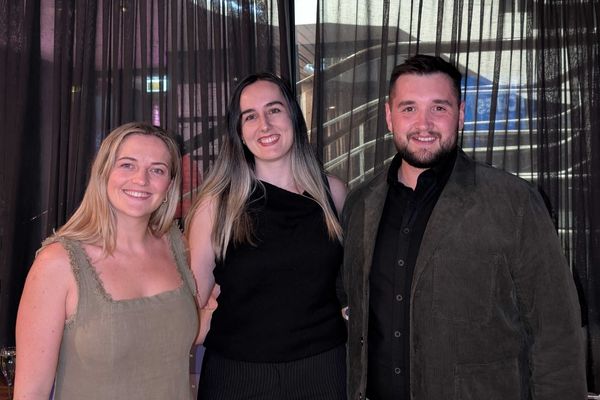
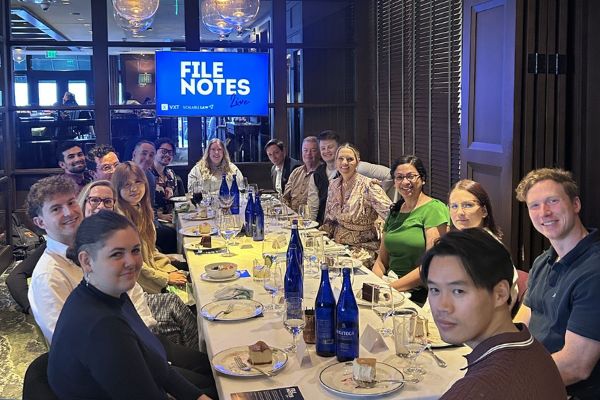
Following events across New Zealand, Australia, Austin, London, and Boston, we finally made it back home, hosting our first-ever File Notes Live in Christchurch.
What is File Notes Live?
File Notes Live is the in-person version of the File Notes podcast, where we dig into the realities of running and growing a successful law firm and explore the careers of the people building them.
At every event, firm owners, operations leaders, and senior lawyers come together for honest conversations about what’s working at their firm and what’s not. The goal is simple: everyone should leave with one or two tangible ideas they can put into action the very next day.
Christchurch marked our ninth File Notes Live. Our guest for this event was Karen MacAskill, who leads operational and digital strategy at Anderson Lloyd.
With a team of 16 and a scope that spans people, processes, and technology, Karen shared her story of recently guiding the firm through a major practice management system transition.
Big themes from Christchurch
Christchurch’s discussion circled around the idea that complex tech projects don’t succeed because of software; they succeed because of people.
From scoping and training to change management and migration risks, Karen shared what worked, what didn’t, and what she’d rethink if she had to do it all again.
Here’s five themes that stood out:
1. Kicking off a major tech project
The evening began with a simple get-to-know-you roundtable: names, firms, roles, and the biggest tech challenge on everyone’s radar.
Unsurprisingly, almost everyone mentioned either a recent migration, a looming software decision, or a desire to modernise without chaos. From there, we dug into the foundational moments of a big project.
Why change?
Karen explained that the trigger for Anderson Lloyd’s shift was a mix of aging systems, growing operational complexity, and the increasingly clear need for a platform that could future-proof the firm.
“Eventually you can’t patch the old thing anymore. The cost of staying still becomes higher than the cost of moving.”
Scoping the work: people, cost and time
A major early lesson was that the work can’t simply be layered on top of everyone’s day jobs. Karen built a specialist project team, blending internal subject-matter experts with external project managers and technical support.
Milestones were mapped early, but one theme emerged across the room: everything takes longer than you think.
Even without a 16-person team, the fundamentals stayed the same:
- Choose one project owner.
- Set clear success criteria.
- Protect time for the work.
- Don’t skip user testing.
2. Learning and development in real life
With a firm of Anderson Lloyd’s size, training becomes its own project.
Design for diverse learners
Karen’s team built videos, quick-reference guides, and live sessions, intentionally creating multiple ways in. Neurodiverse colleagues helped shape formats, leading to shorter, tighter, more digestible content.
Give people space to learn
Training is not homework. Carving out real calendar time was essential.
Core vs advanced training
The team prioritied a shared baseline first: navigation, matter creation and essential workflows, before layering in advanced modules months later.
Measuring adoption
Usage reporting, audits, and informal check-ins helped catch “old-system creep”.
Learning from other firms
Anderson Lloyd paired with another firm going live the same day swapping ideas, testing assumptions, and building collateral together.
“Your ‘competitors’ can become your best R&D function.”
3. Change management (the human stuff)
This part of the conversation had the most laughter (and the most knowing groans).
Getting buy-in from different groups
The hardest groups weren’t necessarily senior or junior, they were the ones who felt the least in control of the change. The solution: involve them early, and listen properly.
Creating champions
Super-users weren’t just early adopters, they were the people who could translate tech into everyday context. Champions carried enormous influence inside the firm.
Preventing change avoidance
The classic “I’ll do it next week”. Karen’s remedy:
- champions embedded in teams
- visible leadership support
“I just want the old system back.”
Everyone hits this dip. The antidote is momentum and reassurance. As Karen put it:
“Don’t confuse discomfort with failure. Change feels uncomfortable…that’s normal.”
4. Migration and technical foundations
No matter how polished a project plan looks, reality hits during migration.
Testing in the real world
Data always reveals skeletons. Always. Scenario-based testing, like real workflows and real-time pressure, surfaced issues no spreadsheet ever could.
Day-one critical list
For Anderson Lloyd, trust accounting and settlements sat at the top. Non-negotiables were protected with:
- Contingency plans
- Manual fallback options
- Enhanced monitoring
Building technical capability
Hiring specifically for data capability was transformative. For firms unsure where to start: prioritise someone who can understand workflow logic and data structures.
Advice for non-technical leaders
Stay close to decisions, even if you don’t write code. Own the outcomes.
5. Planning the next phase: Integrations, AI and optimisation
With the new system live, the conversation shifted to “what next?”
Future roadmap
Anderson Lloyd chose the cloud with a deliberate view toward future integrations, knowing this project was step one, not the finish line.
Deciding what to integrate first
Start with:
- workflows with high admin load
- client-facing friction points
- tasks your people openly hate doing
Phone system integrations
Phone system integrations are often overlooked, but they're crucial for maintaining full context across matters and documenting key moments in client communications.
VXT is the only phone system built specifically for law firms, with direct integrations into your PMS.
With VXT, you capture every call, voicemail, and SMS directly into your PMS, creating a complete communication record that can be searched, summarised, and analysed.
What’s next for Anderson Lloyd?
Karen’s team is now leaning into:
- Integrations
- Automation
- Smarter reporting
- Emerging AI capabilities
Key takeaways from Christchurch
File Notes Live Christchurch reinforced a truth felt across every File Notes Live event:
Technology projects are people projects with software attached.
Here were the standout lessons for successful tech rollouts:
- Protect the foundations: Good scoping and realistic timelines save pain later.
- Train for real habits, not theoretical knowledge: Learning must be practical and ongoing.
- Champion your champions: Change spreads through influence, not instructions.
- Expect a marathon, not a sprint: Go-live is the starting line, not the finish.
- Build for the future: Cloud, integrations, and AI aren’t buzzwords, they’re strategic decisions.
A huge thank you to Karen, the Anderson Lloyd team, our partners OneLaw and VXT, and to everyone who joined us in Christchurch. This community continues to grow because of leaders who show up ready to share openly and learn from one another.
Want to join the next File Notes Live?
Sign up for the File Notes newsletter below to be the first to hear when invites go out.
We haven’t locked in our next event yet. Want us to bring File Notes Live to your city?
Send me an email and tell us where we should go next.
And if you haven’t already, check out the File Notes podcast for conversations with the leaders shaping the future of legal practice.